
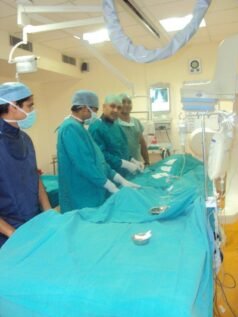
MYTH No 1 – It is a dangerous procedure.
No, It is a very safe procedure with chances of a major complication of less than a 1%
MYTH No 2 It can treat / open the “blockage”.
No – Angiography is simply a test that determines the degree of blockage in the blood vessels of the heart (coronary arteries). Only then can the treating cardiologist make a decision on the course of treatment that must be taken.
MYTH No 3. A cut is made and it is always done through the leg.
Nowadays, many cardiologists perform this procedure through the wrist; this is known as a “Transradial” procedure, and there is usually no need for a cut or stitch. The patient walks in and out after the test.
MYTH No 4 The patient is made unconscious during the procedure.
No. It is always performed under local anaesthesia, with a local anaesthetic drug injected under the skin.
MYTH No 5 . It is a painful procedure.
No -it is a practically painless procedure and usually only the discomfort of the local anesthetic injection is all that one feels. In majority patients don’t even realize when the procedure has started or finished.
MYTH No 6. One has to take rest for a few days thereafter.
No – Nowadays, most doctors perform this procedure as a “day care” procedure, with patients arriving in the morning and leaving in the evening. They can usually start work the next day.
MYTH No 7. It cannot be done if a patient has a heart attack.
False- In fact, performing an emergency angiography followed by angioplasty (i.e., opening up the blocked heart vessel) during a heart attack is the best form of treatment that can be given to such patients and is usually lifesaving.
MYTH No 8. After an angiography one has to undergo an immediate angioplasty
False – Except in rare cases, such as a heart attack, there is usually no emergency/medical justification for an angioplasty to be performed immediately after an angiography. It is usually only a matter of convenience because the patient does not have to go through another needle puncture.
MYTH No 9. All blockages found on angiography need to be opened up.
False – Angioplasty is typically used to open only “functionally and hemodynamically significant” blockages. Thus, if the blockage is less than 70%, medications are usually the only option. Finally, your treating cardiologist will be the best person to advise you on this.
MYTH No 10. It is a costly procedure.
False – With the advent of day care angiography, this is no longer an expensive procedure and is often significantly less expensive than other imaging modalities.